


James Hillman on “Life, Capitalism, Protestantism, the Soul, the Psyche, Our Biosphere and more…”
This TREETV interview is the one the best overviews I’ve come across in describing both the physiological and ecological mess humanity presently faces. It’s tragic that our political leaders are plagued by sheer ineptitude — that is, a lust for power at the cost of failing to see the interconnection between all living things. I fear our assumption, or more accurately, the illusion of “growing the world’s economy” will be humanity’s undoing.
~Keith Basar
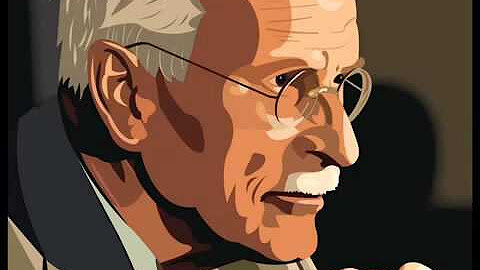
“Tribute to Carl Jung” by Alan Watts — and Jung’s Lecture (excerpt) ‘The Shadow Self to Religious Life’
I’m sitting late at night in a lonely cottage in the country surrounded by many favorite books which I’ve collected over a number of years. And as I look up at the shelves, I see that there’s a very large space. Occupied by the volumes of one man. Carl Gustav Jung, who left this world not more than a few weeks ago. And I’d like to talk tonight about some of the great things that I feel that Jung has done for me. And also the things which I feel to be his enduring contributions toward the science of psychology of which he was such a great master. I began to read Jung when I first began to study Eastern philosophy in my late adolescence. And I’m eternally grateful to him for what I would call a sort of balancing influence on the development of my thought. As an adolescent, in rebellion against the sterile Christianity, in which I was brought up, I was liable to go absolutely overboard for exotic and foreign ideas. Until I read the extraordinarily wise commentary that he wrote to Richard Wilhelm’s translation of the Chinese Taoist text called the “Secret of the Golden Flower.” And it was Jung who helped me to remind myself that I was by, upbringing in by tradition, always a Westerner and I couldn’t escape from my own cultural conditioning.

“On Received, Intellectual and Experiential Wisdom” (Course One) by Renee Chen
Interwoven with an exploration of denial, ignorance and naïveté — a cross-examination of Buddhist teachings and psychodynamic theory
Opening Thoughts
I’ve been pondering a lot about the differences between denial, ignorance and naiveté, and how media popularization of the term “woke” in the last couple of years has, at least for me, undermined and downplayed my understanding and desire to understand some very complex, urgent and critical issues.

“Why Self-Compassion Trumps Self-Esteem” by Kristin Neff
In this incredibly competitive society of ours, how many of us truly feel good about ourselves?
I remember once, as a freshman in college, after spending hours getting ready for a big party, I complained to my boyfriend that my hair, makeup, and outfit were woefully inadequate. He tried to reassure me by saying, “Don’t worry, you look fine.”
“Fine? Oh great, I always wanted to look fine . . .”
The desire to feel special is understandable. The problem is that by definition it’s impossible for everyone to be above average at the same time. Although there are some ways in which we excel, there is always someone smarter, prettier, more successful. How do we cope with this?
SUPPORT ‘GREATER GOOD MAGAZINE’
AND THE GOOD WORK OF Kristin Neff, Ph.D

“The Offered Heart” by Jeannie Zandi
I invite you to close your eyes and imagine that the quiet and sweet darkness you sit in is the cave of your own sacred heart. Let your attention drop into the feel and texture of your heart area, letting it rest about two inches deep inside. Notice the feel, keep your attention there, as though there is a small object about the size of a quarter that are you are focusing on. And imagine the dark cave all around you, a cave whose air is alive with breath and life and energy. Turn away from the external world and the world of the mind and take sweet shelter in your own heart, with the reverence that you would treat any temple, mosque, church, hogan, or zendo. There you sit in the center of your innermost being sanctuary. Precious chalice of the Holy. Simplicity. Quiet. Ground. Breath.

“Consciousness as God” (excerpt - ‘From Science to God’) by Peter Russell —— bonus content: Youtube interview entitled, ‘A REVOLUTION IN CONSCIOUSNESS ’
To many, the statement "I am God" rings of blasphemy. God, according to conventional religion, is the supreme deity, the almighty eternal omniscient creator. How can any lowly human being claim that he or she is God?
When the fourteenth-century Christian priest and mystic Meister Eckhart preached that "God and I are One" he was brought before Pope John XXII and forced to "recant everything that he had falsely taught." Others suffered a worse fate. The tenth-century Islamic mystic al-Hallãj was crucified for using language that claimed an identity with God.
PURCHASE ‘FROM SCIENCE TO GOD’

“Three Kinds of People” by Michael Meade
An old idea suggests there are but three kinds of people in this world. The first kind of person tends to be preoccupied with self-interest as everything refers back to “I, me and mine.” At this basic level the world can be divided into winners and losers as self-assertion rules the day and excesses of aggression and rule-breaking can seem justified. Often, the only restraints on self-aggrandizement become the fear of public shaming or the threat of condemnation and punishment by law.

“Exploring the Inner Journey of Kahlil Gibran” by Paul-Gordon Chandler
A hushed reflective silence filled the dark cinema as the world premiere of The Prophet finished its animated adaptation of Kahlil Gibran’s inspiring book of prose poetry. I had journeyed to the Toronto International Film Festival to experience the unveiling of Salma Hayek’s creative production firsthand and was not alone in feeling the power of Gibran’s words and images reaching across the decades, seemingly so apropos in our modern search for connection with “the other.” In speaking to Salma afterwards she explained her motivation in bringing Gibran’s work to life: “I thought it was crucial that we pay further tribute to this man who was an Arab who wrote a book of spiritual philosophy that unites all religions and all countries and all creeds, from many different generations . . .” In that brief comments, Salma captured the essence of Gibran’s inner journey: the deeper he went, the wider his embrace became.
BE A SUPPORTER OF THE WRITINGS OF PAUL-GORDON CHANDLER and THE INTERFAITH OBSERVER

“Expanding Our Sphere” by Galen Pearl
A minister was giving what I call an “audition sermon” at a church, in hopes of being called as their pastor. After the sermon, members of the congregation were invited to ask questions. Like many churches, this one was becoming smaller and grayer as the members aged. One person asked the minister what he would do to “grow” the church. He responded, “That depends on what you are willing to risk. Everyone like you is already here.”
BE A SUPPORTER OF MS. PEARLS INSPIRING BLOG

“World-Healing Wisdom: Karen Armstrong’s Vision for a Compassionate Future” by Nadia Colburn
The author of more than 20 books, Armstrong has been called “arguably the most lucid, wide-ranging and consistently interesting religion writer today.” Her perspective has been shaped by her life. At the age of 17, she entered a Catholic convent. Six years later, on the verge of a nervous breakdown, she left, wanting nothing more to do with religion. She spent the next 13 years absorbed in secular life, first as an academic and then as a secondary school literature teacher in England. Her first book, Through the Narrow Gate: A Memoir of Spiritual Discovery, was first published in 1981 and chronicles her difficult time in the nunnery and her departure from it. The book launched her as a popular critic of established religion.
Like what you’re reading? YES! is nonprofit and relies on reader support. Click here to chip in $5 or more to help us keep the inspiration coming.

“Jesus: His Religion” – (Pt. 2) by Alan Watts
So, let’s suppose then that Jesus had such an experience. But, you see, Jesus has a limitation, that he doesn’t know of any religion other than those of the immediate Near East. He might know something about Egyptian religion, and perhaps a little bit about Greek religion, but mostly about Hebrew. There is no evidence whatsoever that he knew anything about India or China. And people who think that Jesus was God assume that he must have known because he would have been omniscient. No, Saint Paul makes it perfectly clear in the Epistle to the Philippians that Jesus renounced his divine powers so as to be Man.
BE A SUPPORTER OF THE ALAN WATTS ORGANIZATION

“Jesus: His Religion” – (Pt. 1) by Alan Watts
Some years ago, I had just given a talk on television in Canada when one of the announcers came up to me and said, “You know, if one can believe that this universe is in the charge of an intelligent and beneficent God, don’t you think He would naturally have provided us with an infallible guide to behavior and to the truth about the universe?” Of course I knew he meant the Bible. I said, “No, I think nothing of the kind, because I think a loving God would not do something to His children that would rot their brains.” Because if we had an infallible guide we would never think for ourselves, and therefore our minds would become atrophied. It is as if my grandfather had left me a million dollars, and I am glad he didn’t. And we have therefore to begin any discussion of the meaning of the life and teachings of Jesus with a look at this thorny question of authority, and especially the authority of Holy Scripture.
BE A SUPPORTER OF THE ALAN WATTS ORGANIZATION

Arius vs Athanasius - Lecture by Dr. Richard Rubenstein - Presented by 21st Century Reformation
In a rare presentation, Richard Rubenstein, author and professor of Conflict Resolution at George Mason University, addresses a conference of One God believers in Atlanta. Rubenstein, author of the book "When Jesus became God" brings us exceptional insights into the great Christian conflicts that surrounded the "Arian" controversy and particularly the council of Nicea in 325 AD. This is a must see for everyone with an interest in church history, the development of post-biblical Christian orthodoxy and/or conflict resolution.

“Stephen Jenkinson On How We Deny Our Mortality” by Erik Hoffner
Stephen Jenkinson wants to teach us how to die well. It’s a skill he believes we have forgotten in our culture. Though not a physician — he has master’s degrees in theological studies and social work — he served for years as program director of a palliative-care center at a major Toronto teaching hospital, where he provided counseling at hundreds of deathbeds. In his job he heard over and over from colleagues that “everyone has their own way of dying,” but he says he rarely saw any evidence of this. The default manner of death was for the dying person to endure — to not die — for as long as possible.
SUPPORT THE SUN MAGAZINE.ORG

“Veil of Ignorance” by philosopher John Rawls
All people are biased by their situations, so how can people agree on a “social contract” to govern how the world should work.
Philosopher John Rawls suggests that we should imagine we sit behind a veil of ignorance that keeps us from knowing who we are and identifying with our personal circumstances. By being ignorant of our circumstances, we can more objectively consider how societies should operate.
Two primary principles supplement Rawls’ veil of ignorance: the liberty principle and the difference principle.
According to the liberty principle, the social contract should try to ensure that everyone enjoys the maximum liberty possible without intruding upon the freedom of others.
PLEASE SUPPORT ETHICS UNWRAPPED & FUTURE LEARN

“Embracing Mystery” by Frederic and Mary Ann Brussa
How to make acceptance of mystery a spiritual practice; the first step, let God be God.
Mystery. It's not much in favor these days. Modern consciousness has little respect for the unseen and the unknown. We're much more comfortable with sound bytes from the experts and tidy philosophical or psychological systems that have an explanation for every situation. Television programs us to think that every problem has a solution that can be found in an hour or two, minus the time for commercials.
BE A SUPPORTER OF “SPIRITUALITY & PRACTICE” AND THE GOOD WORK OF FREDERIC AND MARY ANN BRUSSAT

“Cutting the Root of Suffering” by Amoda Maa
You may spend a lifetime — or even lifetimes — looking for what you think is missing, all the time missing what’s already right here inside you. You may look for romantic relationship to give you love, for success to give you recognition, for money to give you richness, for knowledge to give you power, or for a guru or a deity or God to give you peace.

On Walking as a “Message to Earth” by Joan Halifax
In Buddhism, we practice aimlessness (apranahita), even in relation to our personal, social and environmental work. It means that we are not so purposive that we destroy the present moment. “What way from here?” poet Han Shan asks his shadow. Just this step. The path is every step. How can we stray from it?
One day when I was walking down the canyon path in Ojai [California], I realized that I was making a literal impression on the Earth. I stopped and turned around to look at my footprints and…
SUPPORT THE UPAYA ZEN CENTER

“Faith and Modernity” by Karen Armstrong
In the Western world, a strong belief in the objective truths of religion, which are viewed as incontrovertible, demonstrable facts, is regarded as essential to the life of faith. When asking if somebody is religious, people often inquire: “Does he or she believe?” as though accepting certain creedal propositions was the prime religious activity. Indeed, faith is equated with belief, but this equation is of recent provenance. Originally the meaning of the word “faith” was akin to trust, as when we say that we have faith in a friend or an ideal. Faith was not an intellectual position but a virtue: it was the careful cultivation, by means of the rituals and myths of religion, of the conviction that, despite all the dispiriting evidence to the contrary, life had some ultimate meaning and value.
SUPPORT WORLDWISDOM.COM AND MS. ARMSTRONGS WORK

“Ambiguity And Paradox, Mystery And Language” by Julia Corbett-Hemeyer
In my previous role as a hospital chaplain here in Muncie, I was with a family gathered at the bedside of a dying family member, keeping vigil as families do at that point. The conversation and associated emotional tenor changed back and forth, sometimes quite rapidly, between sadness, grief and mourning their loved one’s impending death, and laughter, sometimes deep belly laughs, as they brought to mind humorous anecdotes from his life. At one point, one of the daughters looked at me and said something to the effect that “You must think we’re nuts by now with all these conflicting emotions.” I assured her that I thought nothing of the sort, that what they were experiencing was quite common and indeed healthy.
BEA SUPPORTER OF JULIA CORBETT-HEMEYER’S GOOD WORK