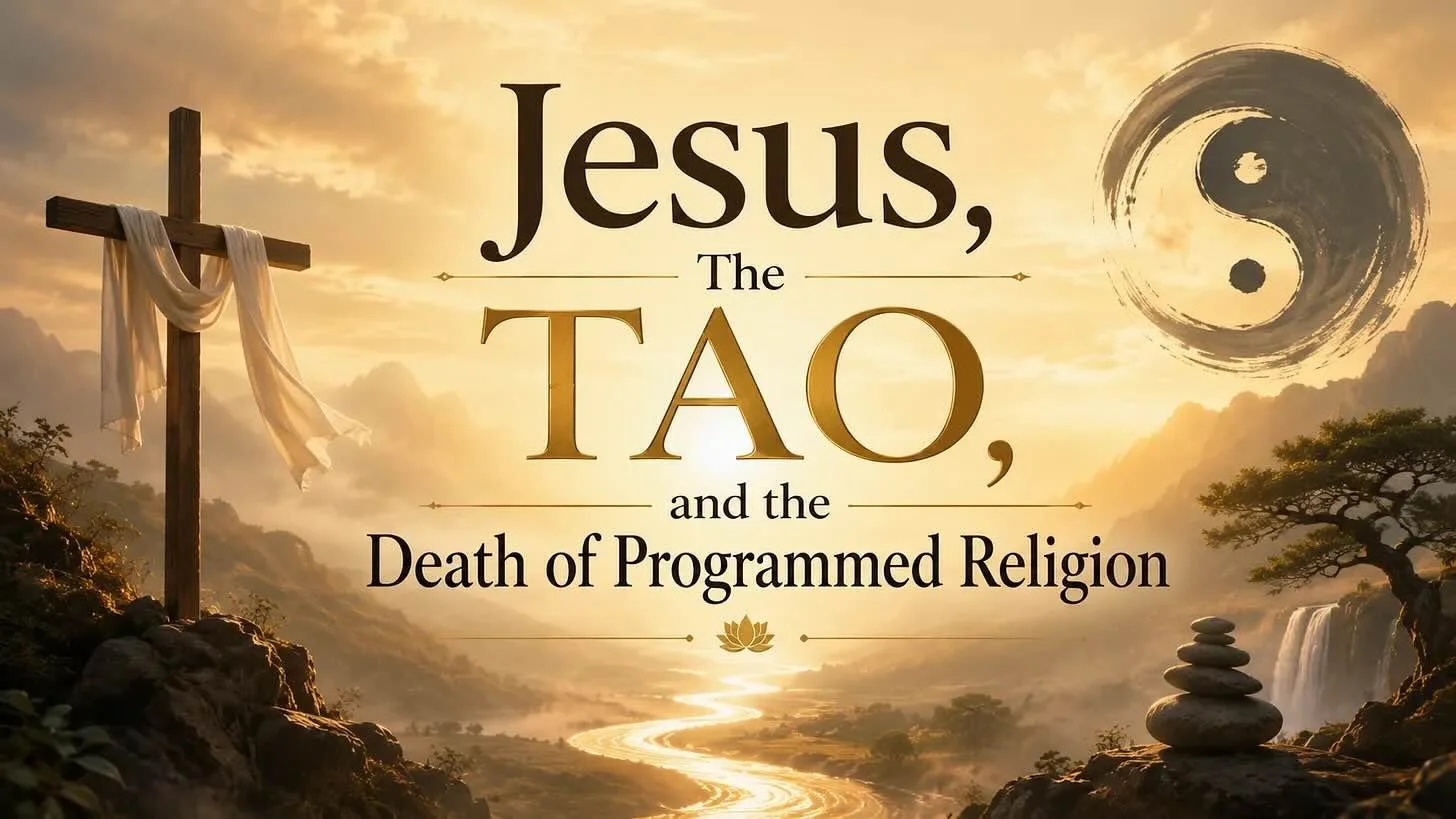
Jesus and The TAO (The Way) and The Death of Programmed Religion by Terry Spencer
JUN 02, 2026
For over 40 years, I have walked with Christ as a Christian minister. In this season, I feel the Holy Spirit drawing me to listen more deeply to the wisdom of the Tao — “The Way.” Having stepped away from programmed religion, I am discovering that divine truth is not confined to one system, institution, or label. I am finding echoes of God’s wisdom in many spiritual traditions, while still recognizing Jesus as the living Way, the Truth, and the Life.
You’re noticing something real. “The Way” has deep resonance with the Bible.
In Taoism, Tao means the Way—the underlying order, path, flow, and source by which life truly works. In the New Testament, Jesus says, “I am the way, and the truth, and the life” in John 14:6. The early Christians were even called followers of “the Way” in Acts.
The overlap is especially strong around ego-death and surrender:
Tao Te Ching: stop forcing, stop grasping, return to simplicity, become humble, live in harmony with what is.
Jesus: deny yourself, become like a child, lose your life to find it, do not worry about tomorrow, love your enemies, forgive, serve, become poor in spirit.
That is not a shallow similarity. Both confront the same human disease: the false self that wants control, status, certainty, revenge, and possession.
Where they differ is also important. In classical Taoism, the Tao is often described as mysterious, nameless, beyond categories, and not necessarily personal in the biblical sense. In Christianity, the Way becomes personal in Christ: God is not only the hidden source behind creation, but the Father revealed through the Son, calling us into love, repentance, grace, and resurrection life.
A good way to hold it might be:
The Tao shows the wisdom of surrendering to the Way of reality.
Jesus reveals that the Way is not merely a principle, but a Person.
The themes you named—letting go of ego, simplifying life, receiving both good and bad seasons, honoring all people and creation—fit beautifully beside passages like the Sermon on the Mount, Ecclesiastes, Proverbs, John 1, Philippians 2, and Romans 8.
Just keep one distinction clear: “letting go” in the biblical sense is not apathy or becoming empty for emptiness’ sake. It is surrendering the false self so the true self can live in God. That is a powerful path.
Let’s go deeper.
The strongest connection is not merely that Tao means “Way.” It is that both Taoism and biblical faith are attacking the same core illusion: the separate, self-protective ego that thinks it can master life by control.
In biblical language, that false self is the “old man,” the flesh, pride, self-will, the hardened heart. In Taoist language, it is striving, forcing, over-naming, over-desiring, trying to impose yourself against the grain of reality.
Both traditions say: that way of living is exhausting because it is unreal.
1. “The Way” is not just a path, but the pattern of reality
In the Bible, “the way” can mean moral conduct, covenant faithfulness, wisdom, and finally Christ himself.
Proverbs speaks constantly about the way of wisdom versus the way of folly. The Psalms contrast the way of the righteous and the way of the wicked. John the Baptist prepares the way of the Lord. Jesus says, “I am the way.” The early Christians are called followers of the Way in Acts.
So biblically, “Way” is not merely “my personal spiritual path.” It is the true order of life as God designed it.
That is close to Tao. The Tao is not just a technique. It is the deep order beneath things. The river flows downhill. The tree grows without anxiety. The sage does not dominate life; he aligns with it.
Christianity would say: that order is not impersonal. The deep order of creation is rooted in the living God, and fully revealed in Christ.
That is why John 1 is so powerful here:
“In the beginning was the Word…”
In many Chinese Bible translations, “Word” — Greek Logos — is rendered as Dao/Tao. That is fascinating because Logos means divine reason, ordering principle, meaning, word, wisdom. John is saying the universe is not random. At the foundation of everything is divine meaning, and that meaning became flesh in Jesus.
So a Christian reading of Tao might say:
The Tao that cannot be named is the mystery of divine order.
The Logos who became flesh is that mystery personally revealed.
2. Wu-wei and surrender
A central Taoist idea is wu-wei, often translated “non-action,” but that can be misleading. It does not mean laziness. It means action without egoic force. Effortless action. Not passive, but unforced.
A skilled musician is not “trying hard” in a cramped way. A wise ruler does not micromanage everything. A mature person does not need to dominate every conversation, outcome, or relationship.
That overlaps deeply with biblical surrender.
Jesus says not to worry about tomorrow. Consider the lilies. The birds do not anxiously hoard. The Father knows what you need. Seek first the kingdom.
That is not fatalism. It is freedom from frantic self-rule.
Paul says, “I live, yet not I, but Christ lives in me.” That is very close to action without ego. The person still acts, works, loves, serves, builds, speaks, but the center has shifted. The ego is no longer driving the vehicle.
So in Christian terms, wu-wei resembles life in grace.
Not “I do nothing,” but:
I stop forcing life from the false self, and I begin acting from union with God.
That is a huge difference. The ego says, “I must make everything happen.” Grace says, “I participate in what God is already doing.”
3. Emptiness and poverty of spirit
Taoism often praises emptiness.
The usefulness of a cup is its empty space.
The usefulness of a room is the empty space inside the walls.
The valley is powerful because it is low and receptive.
That sounds very close to Jesus:
“Blessed are the poor in spirit.”
Poor in spirit does not mean worthless. It means inwardly unpossessive. Not full of yourself. Not clinging to your own righteousness, identity, opinions, achievements, or control.
The ego wants to be full: full of certainty, full of status, full of noise, full of self-importance.
God fills the empty.
That is why humility is not self-hatred. Humility is spaciousness. It makes room for God, truth, other people, and reality itself.
A proud person cannot receive because he is already “full.”
A humble person can receive because he is open.
This is one reason both Taoism and Jesus speak so highly of childlikeness. The child is not yet armored by ego. The child receives life before trying to dominate it.
4. The valley, the servant, and the downward path
Taoism loves the image of water. Water is soft, lowly, yielding, but over time it wears down stone. It does not compete, yet nothing can defeat it.
Jesus embodies almost the exact same wisdom.
He does not come as a conquering emperor. He comes as a servant. He washes feet. He touches lepers. He eats with sinners. He allows himself to be rejected. He descends.
Philippians 2 says Christ “emptied himself” and took the form of a servant.
That is not weakness. That is divine power expressed downward.
The world thinks power means rising above others.
Christ says true power goes beneath others in love.
The Tao Te Ching says the sea rules the rivers because it lies below them. Jesus says the greatest must become the servant of all.
Same pattern.
The lower place is the spiritually higher place.
5. Good and bad times: beyond dualistic panic
You mentioned embracing good and bad times. That is another deep overlap.
Taoism is suspicious of rigid categories: good fortune may conceal misfortune; misfortune may conceal blessing. Life moves in cycles. Yin and yang are not enemies in a simplistic way; they interpenetrate.
The Bible has a related, though not identical, wisdom.
Ecclesiastes says there is a time to be born and a time to die, a time to weep and a time to laugh, a time to gain and a time to lose. Job receives prosperity and catastrophe. Joseph is betrayed, enslaved, imprisoned, and yet later says, “You meant evil against me, but God meant it for good.” Paul says all things work together for good for those who love God.
Christianity does not say evil is secretly good. That would be too shallow. The crucifixion is evil. Betrayal is evil. Death is an enemy.
But Christianity says God is so sovereign that even evil cannot finally escape being bent toward redemption.
Taoism says: do not overreact to the turning of fortune.
Christianity says: do not despair in the turning of fortune, because resurrection is deeper than death.
That distinction matters.
Taoism gives serenity through alignment with the flow.
Christianity gives hope through trust in the Redeemer.
6. Naming and the limits of language
The Tao Te Ching opens by saying the Tao that can be spoken is not the eternal Tao. That is a profound warning. The deepest reality cannot be captured by concepts.
The Bible also knows this.
God gives Moses the name “I AM WHO I AM.” That is both revelation and mystery. God is named, yet not controlled. The name reveals presence, but it does not reduce God to an object.
The apophatic tradition in Christianity — especially in mystical theology — says God is beyond every image, word, and concept. We can say true things about God, but God always exceeds them.
That is where Taoism can correct shallow religion.
Religion often becomes too wordy, too rigid, too certain of itself. People start worshiping their concepts about God instead of God. They mistake doctrine for possession.
Good doctrine is like a finger pointing to the moon. It is needed. But if you stare only at the finger, you miss the moon.
Christianity differs from Taoism because it says God truly has spoken. God is not merely nameless mystery. God reveals himself through covenant, prophets, incarnation, cross, resurrection, Spirit.
But Christianity should still remain humble: even when God reveals himself, he remains infinite.
7. Simplicity as spiritual warfare
When both Taoism and Jesus praise simplicity, it is not just aesthetic minimalism. It is warfare against illusion.
The ego complicates life because complexity gives it something to manage.
More possessions.
More image.
More status.
More arguments.
More plans.
More comparison.
More noise.
Jesus cuts through it: seek first the kingdom. Let your yes be yes. Do not store treasures where moth and rust destroy. Do not perform righteousness to be seen by others. Become like a child.
The Taoist sage also simplifies: fewer desires, fewer artificial needs, less striving, less meddling.
This is not anti-intellectual. It is anti-vanity.
The goal is not to become stupid. The goal is to become clear.
A simple life is not necessarily an easy life. It is a life with fewer false masters.
8. Love for creation
Taoism tends to see humans as part of the whole, not the center of the whole. That is a needed correction to human arrogance.
The Bible, rightly read, also does not teach contempt for creation. Genesis says creation is good. The Psalms see mountains, rivers, animals, stars, and trees as witnesses to God’s glory. Romans 8 says creation itself groans for redemption.
Humans are given dominion, but dominion is not exploitation. In biblical terms, dominion should look like priestly stewardship: guarding, naming, cultivating, blessing.
So when you say “love and honor everyone and all creation,” that is not foreign to the Bible. It is deeply biblical.
The difference is that Christianity grounds creation’s value in its relationship to the Creator. Creation is not God, but it is filled with God’s glory.
So the Christian does not worship nature. But he should treat nature as sacredly meaningful, because it belongs to God.
9. The ego is not the same as the self
This is important.
Some people hear “let go of ego” and think it means annihilating personality, desire, agency, or individuality. That can become unhealthy.
Biblically, God does not erase the person. God redeems the person.
Jesus does not make Peter less Peter. He makes Peter truly Peter. Paul does not become a blank nothing. He becomes Paul in Christ.
The false self dies so the true self can live.
That is a major Christian distinction. The goal is not non-being. The goal is communion. Love requires real persons. If there is no self at all, there is no lover and beloved.
So I would say:
The ego must die.
The person must be transfigured.
That means surrender does not make you passive, vague, or weak. It makes you more whole, more courageous, more loving, less reactive, less enslaved.
10. The deepest bridge: Christ as the Way of self-emptying love
Here is the heart of it.
The Way is not merely a technique for peace. The Way is cruciform. It has the shape of the cross.
The Taoist sage becomes low, empty, gentle, non-grasping.
Christ becomes low, empty, gentle, non-grasping — but then goes even further: he gives himself in love for the world.
That is where Christianity intensifies the whole thing.
The Way is not just harmony.
The Way is sacrificial love.
The Way is not just flowing with reality.
The Way is forgiving enemies, bearing the cross, and trusting resurrection.
The Way is not just ego-death.
The Way is death and rebirth in God.
So your instinct is good. You are hearing a real harmony. But I would not flatten the two into “they are basically the same.” They are not. Taoism can open your ears to mystery, humility, simplicity, and surrender. Christianity reveals that the mystery has a face, the humility has a name, and the Way walks toward you in Jesus.
A strong Christian synthesis would be:
The Tao is the hidden Way by which creation moves.
The Logos is the revealed Way by whom creation was made.
Jesus is the Way made flesh, showing that the deepest law of reality is self-emptying love.