

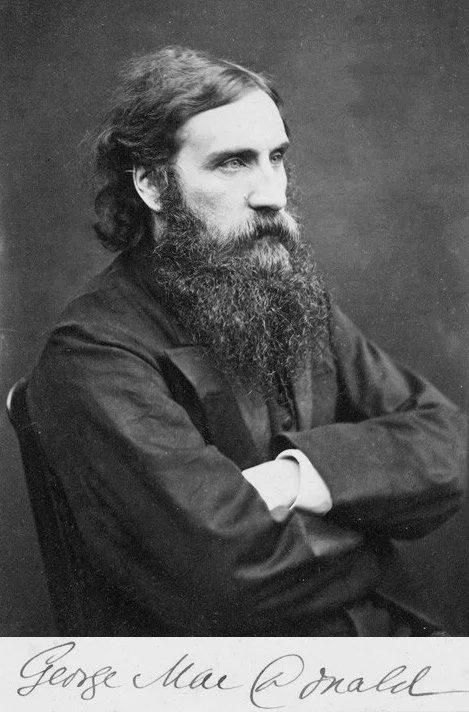
He was fired from his church for saying God's love was too big. Dying and broke, he wrote stories that would quietly invent modern fantasy—and without him, there would be no Narnia, no Middle-earth.
In 1853, the Reverend George Mac Donald stood before his congregation in Arundel, England, and preached a sermon that would end his career. He said that God's love had no limits. That redemption wasn't reserved for a chosen few. That even the souls in hell might one day be saved-because divine love, if it was truly infinite, couldn't abandon anyone forever. The congregation was horrified!
This wasn't theology. This was heresy. In Victorian England, you didn't question damnation. You didn't suggest that hell might not be eternal. You certainly didn't imply that everyone-murderers, blasphemers, the unrepentant—might eventually be redeemed. The church elders called a vote. They cut his salary. Then they forced him out entirely.
George MacDonald, at 29 years old, was unemployed, publicly disgraced, and responsible for a growing family.
He had tuberculosis—coughing blood, struggling to breathe, knowing the disease could kill him at any time. He had no income, no prospects, and eleven children to feed. So he did the only thing he could: he started writing.
At first, it was just to survive. He wrote sermons, essays, anything that might bring in a few pounds. But then something shifted. He started writing stories-strange, dreamlike tales that blurred the line between fairy tale and spiritual meditation.
In 1858, he published Phantastes: A Faerie Romance for Men and Women (1858). It was unlike anything Victorian readers had seen. Not a children's story. Not a straightforward allegory. It was a fever dream of a book—a young man wandering through a magical realm where trees had souls, shadows could kill you, and nothing was quite what it seemed.
The book flopped. Critics didn't know what to make of it. It sold poorly. MacDonald remained broke. But here's the thing about certain books: they don't need massive sales. They just need to find the right reader.
In 1916, a teenage C.S. Lewis was waiting at a train station when he picked up a worn copy of Phantastes from a bookstall. He later described what happened next as his imagination being "baptized."
Lewis had been raised Christian, lost his faith, and was wandering through life as a skeptical atheist. But Phantastes did something no sermon ever had—it made him feel the presence of something holy, something beyond reason, something that couldn't be argued into existence but could only be experienced. He didn't convert immediately. That would take years. But the seed was planted-not through doctrine, but through story.
Decades later, when Lewis became one of the most famous Christian writers in the world, he wrote: "I have never concealed the fact that I regarded George MacDonald as my master; indeed, I fancy I have never written a book in which I did not quote from him." Without George MacDonald, there is no C.S. Lewis. And without C.S. Lewis, there is no Chronicles of Narnia-no Aslan, no wardrobe, no "further up and further in." But it didn't stop there.
J.R.R. Tolkien, Lewis's close friend, also read MacDonald.
While Tolkien was more critical of MacDonald's writing style, he absorbed something deeper: the idea that fantasy wasn't escapism. It wasn't frivolous. It could reveal truths that realism couldn't touch. Tolkien called it "eucatastrophe"—the sudden joyous turn in a story that gives a glimpse of ultimate truth. He learned that from MacDonald.
Without MacDonald, there's no The Lord of the Rings. No hobbits. No "I will take the Ring to Mordor."
The entire modern fantasy genre-the one that dominates bookstores, movies, and TV today-traces its DNA back to a sick, broke Scottish minister who was fired for loving God too much. But here's the tragedy: George MacDonald never knew. He spent his entire life struggling. He wrote over 50 books—novels, fairy tales, poetry, sermons. Some sold decently. Most didn't. He never made enough money. His tuberculosis worsened. Several of his children died young.
In 1902, at age 78, MacDonald moved to Italy, hoping the warmer climate would help his failing lungs. He lived in a small cottage in Bordighera, far from home, barely scraping by.
He died in 1905, largely forgotten.
No literary fame. No financial security. No recognition that his stories had changed anything. He died thinking he had failed. What he didn't know: at that exact moment, a young C.S. Lewis was growing up in Ireland, just a few years away from picking up Phantastes at that train station. What he didn't know: his ideas about fantasy, mythology, and spiritual truth were already quietly spreading through the writers who would shape the 20th century. What he didn't know: he had invented something that didn't even have a name yet-modern fantasy literature.
It wasn't until decades after his death that people started connecting the dots. Critics began noticing how much Lewis quoted MacDonald. Tolkien scholars traced certain ideas back to MacDonald's essays. Fantasy writers rediscovered his books and realized: Oh. This is where it all started.
Today, if you've ever read Harry Potter, The Chronicles of Narnia, The Lord of the Rings, His Dark Materials, or any modern fantasy novel—you've been touched by George MacDonald's imagination. If you've ever watched a fantasy movie where a character faces darkness and chooses light, where redemption feels possible even for the broken—you're seeing MacDonald's theology, the one he was fired for preaching, smuggled into story form.
The church told him his ideas were wrong. That God's love couldn't work the way he described. That some people were beyond saving. So he stopped preaching and started writing fairy tales. And in those fairy tales-hidden in talking trees and enchanted castles and magical transformations—he planted the same radical idea: that no one is beyond redemption. That love is stronger than darkness. That the universe bends toward grace.
The church rejected the sermon. But the stories? The But the stories? The stories spread everywhere.
Here's what haunts me about George MacDonald: He was fired for believing in a love too big for his time. He died thinking he'd accomplished nothing. But his imagination became the secret foundation of the most beloved stories of the next century. Which means maybe the most important work we do isn't the work that gets recognized. Maybe it's the quiet, invisible work-the stories we tell, the ideas we plant, the seeds we scatter without ever seeing them grow.
George MacDonald scattered seeds in poverty and obscurity. He never saw the forest. But we're living in it. He was fired for saying God's love had no limits. Dying and broke, he wrote fairy tales instead. Those fairy tales quietly invented modern fantasy.