

"The Obscenity of Belief in an Eternal Hell” (excerpt) by David Bentley Hart
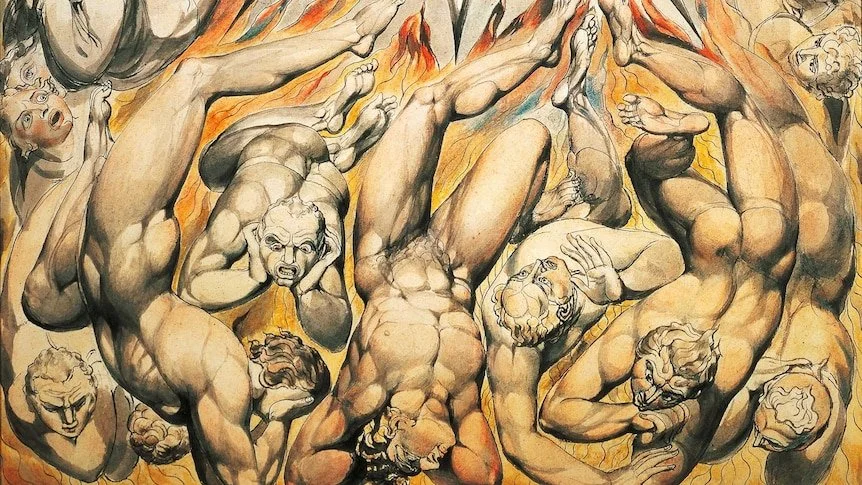
“Casting the rebel angels into Hell”, by William Blake. (Museum of Fine Arts, Boston; Photo by DeAgostini / Getty Images.)
My friends’ son is now old enough to grant me permission to tell this story, but it happened more than a dozen years ago, when he was only seven or eight. The year before, he had been diagnosed as having Asperger’s syndrome. He was an extremely intelligent child, shy, typically gentle and quiet, but occasionally emotionally volatile — as tends to be the case with many children classified as “on the spectrum”. They are often intensely sensitive to, and largely defenceless against, extreme experiences: crowds, loud noises, overwhelming sensory stimulation of any kind, but also pronounced imaginative, affective, or moral dissonances.
So it should have surprised no one when he fell into a state of panic for three days, and then into an extended period of depression, after a Dominican homilist who was visiting his parish happened to mention the eternity of hell in a sermon. But it did in fact surprise his parents, for they had not realised until then that he had never before consciously absorbed the traditional Christian picture of damnation. Now that he had, his reaction was one of despair.
All at once, he found himself imprisoned in a universe of absolute horror, and nothing could calm him until his father succeeded in convincing him that the priest had been repeating lies whose only purpose was to terrorise people into submission. This helped him regain his composure, but not his willingness to attend church; if his parents so much as suggested the possibility, he would slip into a narrow space behind the balustrade of the staircase where they could not reach him. And soon they came to see the matter from his perspective. As a result, they have not gone to mass since that time, except as non-communicating guests at a few weddings, and have long since lost any interest in doing so.
Now, to me it seems obvious — if chiefly at an intuitive level — that this story is more than sufficient evidence of the spiritual squalor of the traditional concept of an eternal hell. After all, another description for a “spectrum” child’s “exaggerated” emotional sensitivity might simply be “acute moral intelligence”. As difficult as it sometimes makes the ordinary business of life, it is precisely this lack of any very resilient emotional insulation against the world’s jagged edges that makes that child incapable of the sort of complacent self-delusion that permits most of us to reconcile ourselves serenely to beliefs that should, soberly considered, cause us revulsion.